History of Charles Rennie Mackintosh
2023-03-01 00:00:00
Charles Rennie Mackintosh’s work is one of Scotland’s most recognisable design legacies, and it continues to inspire beautiful pewter gifts today. Here, we look at his life, the Glasgow Style, and why his mix of structure, elegance and natural detail works so well in pewter.
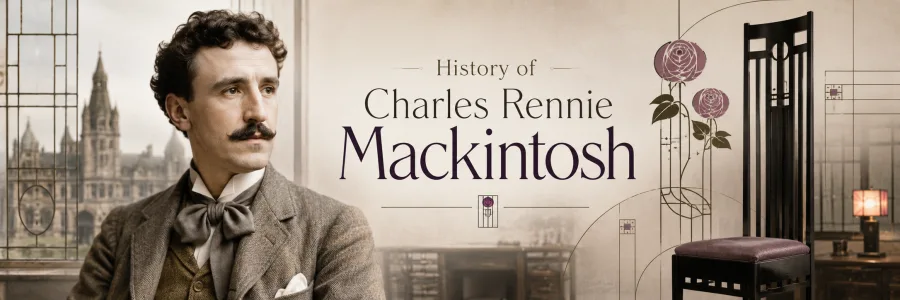
Charles Rennie Mackintosh remains one of Scotland’s most influential designers. Best known as an architect, artist and leading figure of the Glasgow Style, he created work that balanced strong lines, elegant proportions and delicate natural motifs. His influence can still be seen today in furniture, interiors, jewellery, textiles, metalwork and decorative gifts.
For pewter collectors and gift buyers, Mackintosh-inspired designs have a lasting appeal. They capture exactly what he did so well: simplicity, graceful detail and a strong sense of craftsmanship.
Who was Charles Rennie Mackintosh?
Charles Rennie Mackintosh was born in Glasgow in 1868 and became one of the most important Scottish designers of the late 19th and early 20th centuries. He studied at Glasgow School of Art and later became closely associated with the building itself, which he famously designed. The Glasgow School of Art holds a nationally significant collection of his work, covering both his student years and wider career.
Mackintosh was far more than an architect. He also worked across interiors, furniture, decorative design and watercolour painting. His style became closely linked with the Glasgow Style, a Scottish version of Art Nouveau that combined clean geometry with stylised flowers, flowing lines and symbolic detail. The National Galleries of Scotland describe him as a leading representative of Art Nouveau in Scotland.
The Glasgow Style and “The Four”
Mackintosh’s creative world was shaped by a small but highly influential group known as The Four. This circle included Charles Rennie Mackintosh, Margaret Macdonald, Frances Macdonald and Herbert MacNair. The Charles Rennie Mackintosh Society identifies them as central figures in the development of the Glasgow Style.
Margaret Macdonald, who later married Mackintosh, was an important artist in her own right. Her symbolic, flowing and decorative work complemented Mackintosh’s more structured architectural approach. Together, their influence helped give Glasgow design an international reputation.
Mackintosh’s design language
Mackintosh’s work is instantly recognisable because it often brings together opposites: straight lines with soft curves, plain surfaces with delicate ornament, and strong structure with natural forms.
Common Mackintosh-inspired features include:
- Tall, elegant lines
- Geometric shapes
- Stylised roses
- Fine linear detail
- Celtic and natural influences
- Balanced, uncluttered decoration
It is easy to see why this style works so well on pewter. Pewter’s soft sheen and smooth surface suit simple, elegant decoration beautifully, without needing heavy ornament.
Pewter and the Arts and Crafts movement
Pewter has a much older history than Mackintosh himself. It is a traditional metal alloy, mostly made from tin, and has been used for centuries for household objects, tableware and decorative pieces.
By the late 19th century, designers were once again looking to handmade objects and traditional craft for inspiration. The Arts and Crafts movement encouraged good design, honest materials and skilled workmanship. In Scotland, the Glasgow School of Art became an important centre for this wider creative movement.
Although Mackintosh is not best known as a pewter maker, his design principles sit naturally alongside pewter craft. His influence can be seen in modern pewter gifts that use clean lines, restrained decoration and stylised floral or Celtic detail.
Mackintosh-inspired pewter gifts today
Today, many pewter pieces are described as Mackintosh-inspired because they echo his design language rather than copy a single original object. These pieces often feature the famous Mackintosh rose, long vertical lines, geometric borders or Art Nouveau-style curves.
Popular Mackintosh-inspired pewter gifts include:
- Vases
- Photo frames
- Trinket boxes
- Jewellery boxes
- Clocks
- Plaques
- Goblets and keepsakes
These designs are especially popular for Scottish gifts, wedding presents, anniversary gifts and decorative homeware.
Why Mackintosh designs still appeal
Mackintosh’s enduring appeal lies in the way his work feels both historic and modern. His designs are decorative, but never fussy. They are unmistakably Scottish in character, yet elegant enough to suit a wide range of homes and tastes.
That balance makes Mackintosh-inspired pewter a thoughtful choice for meaningful gifts. A pewter vase or keepsake box with a Mackintosh rose design feels traditional, artistic and timeless all at once.
Choosing a Mackintosh-inspired pewter gift
When choosing a Mackintosh-style pewter piece, think about the occasion and how the item will be used.
For weddings or anniversaries, a vase, clock or photo frame works beautifully because it becomes part of the home. For birthdays, a jewellery box or trinket box makes a more personal keepsake. For Scottish heritage gifts, designs with roses, Celtic lines or Glasgow Style detail are especially fitting.
If engraving is available, a short message, name or date can make the gift feel even more personal.
Caring for pewter
Pewter is easy to care for. Wash by hand with warm water and mild washing-up liquid, then dry with a soft cloth. Avoid dishwashers, abrasive cleaners and harsh metal polish.
Modern lead-free pewter has a soft, warm shine. It does not need to look like silver; part of its charm is its gentler, more traditional finish.
Explore Mackintosh-inspired pewter gifts
Mackintosh-inspired pewter gifts bring together Scottish design heritage and traditional craftsmanship. With their elegant lines, stylised floral details and soft pewter finish, they make thoughtful presents for birthdays, weddings, anniversaries and special occasions.
Whether you choose a vase, frame, box or decorative keepsake, a Mackintosh-style pewter gift is a lasting reminder of one of Scotland’s most distinctive design traditions.
If you are looking for a gift with real character, take a look at Pewter World’s range of pewter gifts and keepsakes for ideas inspired by timeless Scottish style.