Port vs Sherry: History, Origins and How They're Made
2024-08-19 00:00:00
Port and Sherry are two of the most famous fortified wines in the world, but they’re very different in style, production and flavour. Here, we take a closer look at where they come from, how they’re made, and what makes each one worth knowing about.
Port vs Sherry: Two Fortified Wines, Two Very Different Stories
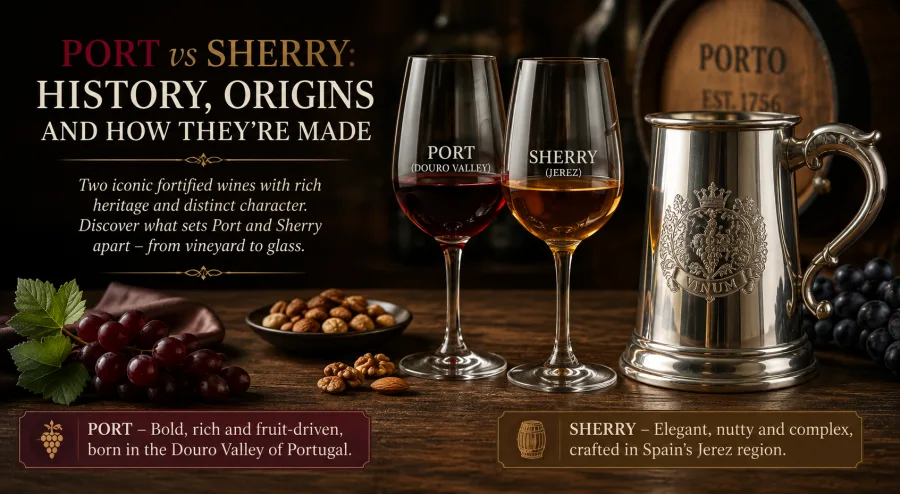
Port and Sherry are both fortified wines with a long and colourful history, yet they are often confused. They share a few broad similarities — both have strong links to Britain, both are shaped by tradition, and both can be wonderfully rewarding in the glass — but that is where the likeness largely ends.
Port is usually rich, fruity and sweet, with a deep warming character that makes it a favourite after dinner. Sherry, on the other hand, can be bone dry, nutty, rich or lusciously sweet depending on the style. If you’ve ever wondered what really separates the two, this guide breaks it down clearly.
What Is Port?
Port wine comes from the Douro Valley in northern Portugal, one of the oldest demarcated wine regions in the world. Wine has been made there for well over 2,000 years, but the fortified style we know today developed later, in the late 17th century.
At that time, British merchants were keen to find reliable alternatives to French wine during periods of conflict with France. Portuguese wines caught their attention, but there was a practical problem: they did not always survive the journey to England in good condition. The answer was fortification. By adding grape spirit during fermentation, producers created a stronger wine that travelled better and kept its sweetness. The result was Port.
That success was formalised in 1756, when the Douro became the first wine region in the world to be legally demarcated. It was an important step in protecting quality, authenticity and production standards.
How Port Is Made
Port’s production method is one of the main reasons it tastes the way it does. The process is relatively short compared with many other wines, which helps preserve both sweetness and intensity.
1. Harvesting and selection
Port is made from native Portuguese grape varieties, including Touriga Nacional, Touriga Franca, Tinta Roriz, Tinta Barroca and Tinta Cão. Grapes are usually hand-picked in late summer or early autumn, when sugar levels are at their best.
After picking, the fruit is carefully sorted. Only healthy grapes are selected, because quality at this stage has a big impact on the finished wine.
2. Crushing and fermentation
Traditionally, grapes were foot-trodden in shallow granite tanks called lagares. Some producers still use this method today, particularly for premium styles, as it can provide gentle but effective extraction. Others use modern mechanical presses and temperature-controlled tanks.
Fermentation begins naturally, but it is only allowed to run for a short period — often just two or three days. This is deliberate. The aim is to convert some of the grape sugars into alcohol while leaving enough behind to create Port’s signature sweetness.
3. Fortification
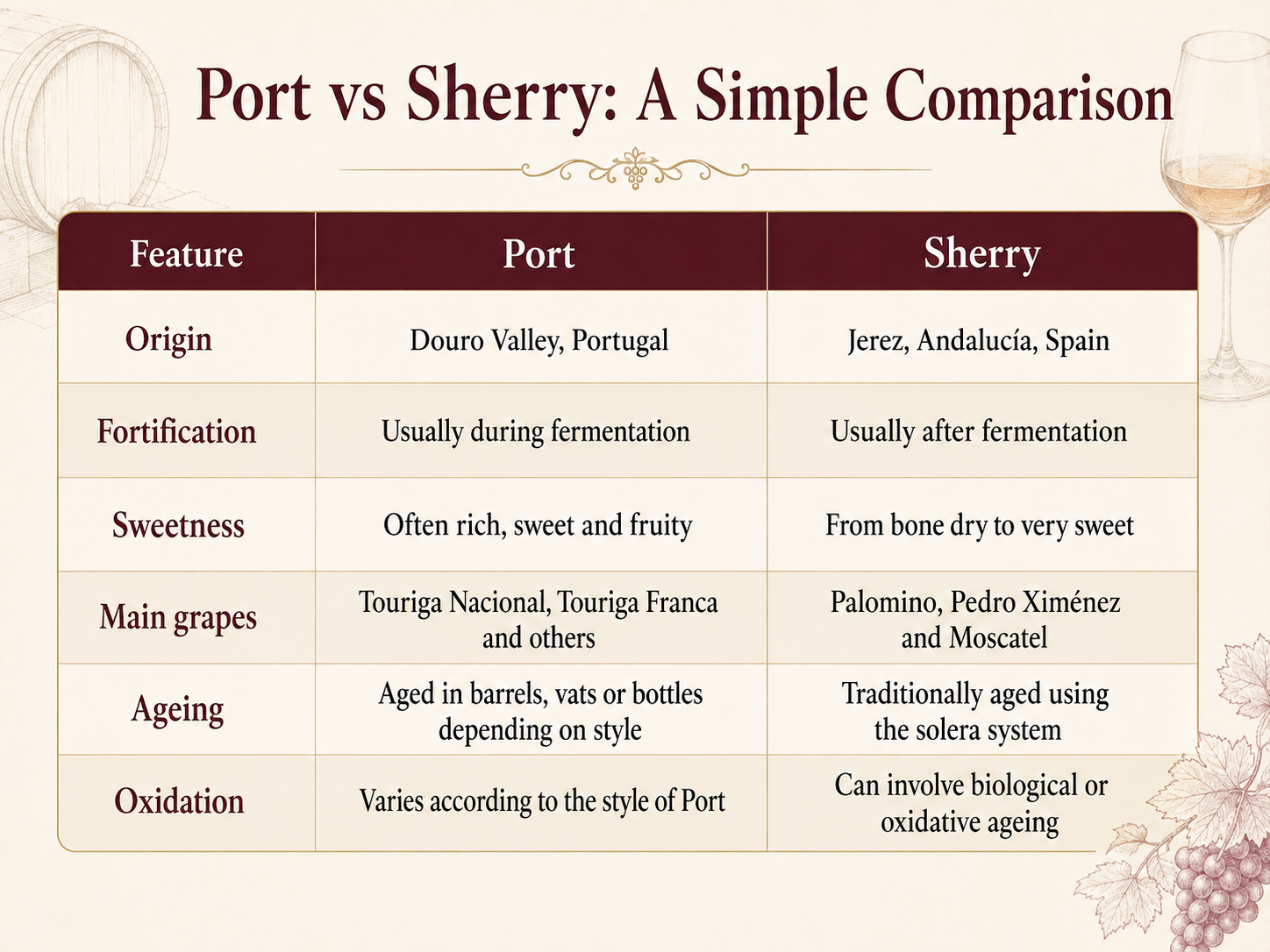
Once the desired level of sweetness has been reached, neutral grape spirit, known as aguardente, is added. This raises the alcohol level to around 19–22% and stops fermentation by killing the yeast.
This single step is what gives Port its rich, sweet, fortified character.
4. Ageing and blending
Port may be aged in wooden casks or in tanks, depending on the style. Wooden ageing allows for slow oxidation, which develops notes of dried fruit, nuts and spice. Tank ageing, by contrast, tends to preserve bright fruit flavours.
Blending is another crucial part of the process. A master blender may combine wines from different vineyards, grape varieties and vintages to achieve the right balance and consistency.
5. Bottling and bottle ageing
Some styles of Port are bottled relatively early, while others continue to develop in bottle for many years. Vintage Port, for example, can age for decades, becoming more complex and layered over time.
What Is Sherry?
Sherry comes from the region around Jerez de la Frontera in Andalucía, southern Spain. In Spanish, it is called Jerez, and its history goes back more than 3,000 years. Phoenicians, Romans, Moors and Spaniards all played a part in shaping the area’s wine culture.
The style we now recognise as Sherry emerged around the 16th century and was heavily influenced by British trade. Over time, the anglicised name “Sherry” became the one most people know today.
By the 18th and 19th centuries, Sherry had become hugely popular in Britain, particularly among importers and wine drinkers who appreciated its versatility.
How Sherry Is Made
Sherry production is more complex than many people expect. Unlike Port, which is typically sweet and fortified during fermentation, Sherry is usually fermented fully before fortification. That makes the base wine dry, even when the final style may taste sweet.
1. Harvesting and grape varieties
The main grape used in Sherry is Palomino, which is best suited to dry styles. Pedro Ximénez (PX) and Moscatel are also important, especially for sweeter wines.
For sweeter styles, the grapes may be sun-dried before fermentation. This concentrates their natural sugars and creates a richer, more intense flavour.
2. Fermentation and classification
The grapes are fully fermented, usually in stainless steel or traditional wooden vats. Because fermentation is allowed to complete, the resulting base wines are dry.
After this stage, the wines are tasted and classified. Lighter, more elegant wines are set aside for styles such as Fino and Manzanilla. Fuller-bodied wines are more likely to become Oloroso.
3. Fortification and flor
The next step depends on the style being produced.
Wines destined to become Fino or Manzanilla are fortified to around 15%, which allows a layer of yeast called flor to develop on the surface. This layer protects the wine from oxidation and contributes fresh, delicate flavours such as almond, bread dough and a faint savoury note.
These conditions are quite specific. Flor needs the right combination of humidity, temperature and alcohol level to thrive.
By contrast, wines fortified above 17% do not support flor. Without that protective layer, they age oxidatively, which leads to deeper colour and richer flavours. That is how Oloroso develops its nutty, robust character.
4. Ageing in the solera system
Sherry is famous for its solera system, a traditional ageing method that is unlike anything used in most other wine regions.
Barrels are stacked in layers called criaderas. The youngest wine sits at the top, and the oldest wine is found at the bottom in the solera. When wine is bottled, only a small amount is drawn from the bottom layer. That barrel is then topped up with wine from the row above, and so on.
The result is a constant blending of younger and older wine. This helps maintain consistency, while also creating depth, complexity and a distinctive house style over many years.
5. Bottling and finishing
Before bottling, some sweeter styles such as Cream or Medium Sherry are blended with sweeter wines, often PX or Moscatel, to achieve the desired balance.
The Key Differences Between Port and Sherry
Which One Should You Choose?
That really depends on your taste.
If you enjoy rich, sweet, full-bodied wines with plum, berry and chocolate notes, Port is likely to be the better fit. It is especially popular as an after-dinner drink and pairs beautifully with cheese, nuts and dark chocolate.
If you prefer something drier, more savoury or more varied, Sherry offers far more range. A chilled Fino can be crisp and refreshing, while an Oloroso or PX can be deep, warming and complex.
In short, Port tends to deliver immediate richness, while Sherry offers a broader spectrum of styles and textures.
A Final Word
Port and Sherry may share a fortified heritage, but each has its own personality. Port is often associated with sweetness, strength and elegance. Sherry is more varied, with styles that can be dry, nutty, crisp or indulgent.
Understanding how they are made makes each glass more interesting. It also helps you choose the right one for the occasion, whether that’s a quiet evening at home, a dinner with friends or a thoughtful gift for someone who appreciates a good tipple.
And if you are looking for something to serve them in, Pewter World has a fine range of handcrafted pieces to make every drink feel that little bit more special.