History Of Pewter
2021-03-08 00:00:00
Pewter has a fascinating story, stretching from the mysteries of the Dark Ages to the polished, lead-free pieces we know today. Here we look at how the metal developed, why guilds played such an important role, and how modern craftsmanship has brought pewter back into favour for beautifully made gifts and homeware.
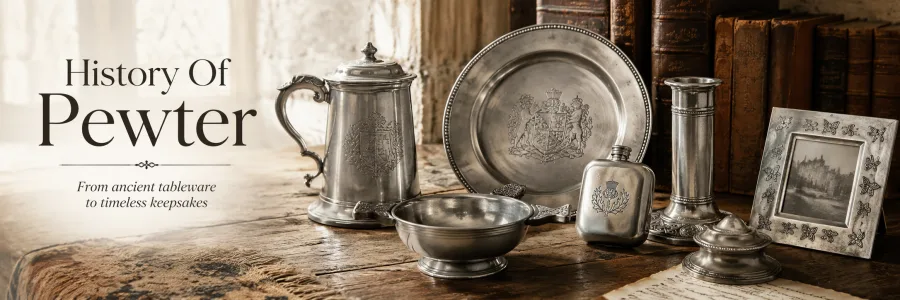
The Evolution of Pewter: From the Dark Ages to Modern Craftsmanship
Pewter has a long and rather intriguing history. From its murky beginnings in the Dark Ages to the lead-free, beautifully finished pieces made today, it has remained a much-loved material for household items, tableware and gifts.
The early history of Pewter
Because written records from the Dark Ages are scarce, the earliest history of Pewter in Europe is not entirely clear. What we do know is that by the 14th century it had become a popular alternative to wood and pottery for everyday household use.
Early Pewter was often far from ideal by modern standards. Roman and medieval alloys could contain as much as 20% to 30% lead, which created obvious problems for drinking vessels and liquid measures. Lead is toxic, and it also causes Pewter to tarnish more quickly, darkening with age and contributing to the old idea of it being a dull grey metal.
Pewter guilds and the fight for quality
As Pewter grew in popularity, craftsmen and guilds worked to improve standards and protect the reputation of the metal. Across Europe, craft guilds brought artisans together to safeguard trade secrets, regulate conduct and ensure the quality of what they made.
One of the best-known examples is the Worshipful Company of Pewterers of London. Formed in 1348 and later granted a Royal Charter in 1473, the Company had the power to seize and destroy Pewter that failed to meet the required standard. It could also fine members who produced inferior ware.
From 1503, Parliament required members to register their touch-marks. These marks were recorded on tablets of Pewter and kept at the Guild Hall. They gave customers confidence in what they were buying, while also protecting the craftsman’s reputation.
The move towards lead-free Pewter
Over time, the composition of Pewter changed significantly. For much of its history, it was common to distinguish between “Fine Pewter”, made from tin hardened with copper in varying proportions, and “Common Pewter”, which included lead.
By the middle of the 16th century, a brighter, harder alloy was developed in Britain. This used tin with a small quantity of antimony and no lead, and it became known as Britannia Metal. It was stronger than ordinary Pewter and could be worked using spinning techniques, opening the door to more refined and varied designs.
Modern standards have continued this move towards safer, higher-quality alloys. Today, lead-free Pewter is the norm, offering durability, a clean finish and the reassuring peace of mind that earlier versions could not always provide.
Pewter in the modern age
The last few decades of the 20th century saw a real resurgence in interest in Pewter. Production moved beyond the small-scale workshop model of the past and into a modern industry, while still retaining the traditional values that made the craft so respected.
Established Pewterers have continued to modernise their methods without losing sight of fine workmanship. At the same time, new makers have brought fresh ideas in design, manufacture and presentation, helping Pewter appeal to a new generation of buyers.
Why Pewter still matters today
Part of the appeal of Pewter is that it bridges old and new so neatly. It carries centuries of history, yet it remains practical, attractive and wonderfully suited to personalised gifts.
Whether it is a tankard, hip flask, engraved plate, goblet or glassware, Pewter offers a timeless look that feels special without being showy. That is a big part of why it continues to hold its place in British craft and in the home.
If you are looking for beautifully made lead-free Pewter pieces, explore Pewter World’s range for gifts that can be personalised with engraving for an extra thoughtful touch.