The King's Shilling Tankard: A Journey Through History
2022-03-02 00:00:00
The King’s Shilling Tankard is more than an old drinking vessel — it’s a fascinating reminder of loyalty, farewells and the traditions that once marked military life. Here we look at where the custom began, why it mattered so much, and how changing times caused it to fade, while keeping its story alive today.
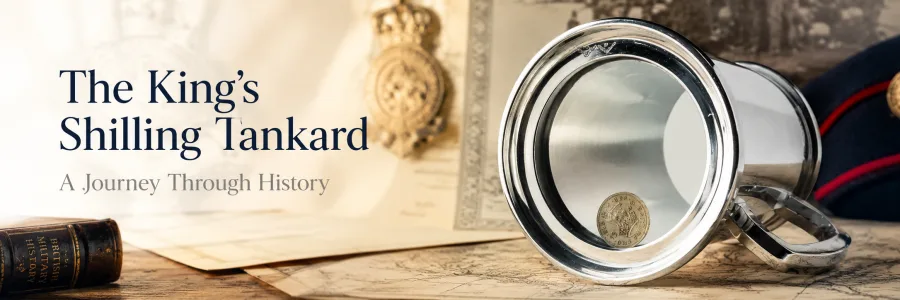
The King’s Shilling Tankard: a tradition with a story to tell
Some objects are more than they first appear. A pewter tankard, a simple shilling coin, a shared drink before departure — together, they carried real meaning for generations of families, soldiers and communities. The King’s Shilling Tankard, sometimes referred to as the Shilling Goblet, is one of those quietly powerful traditions: practical, personal, and full of emotion.
Today, it stands as a reminder of a time when rituals helped people cope with duty, distance and uncertainty. Its story is tied to military history, family life and the way communities marked important moments with a toast. Although the custom is no longer widely practised, it still captures the imagination.
Where the tradition began
The roots of the King’s Shilling Tankard can be traced back to medieval Europe, when military service was very different from what it is today. In those times, impressment was common. Men could be forced into service, often with little warning and not much chance to say farewell.
Out of that difficult reality, a gentler custom emerged. Before a soldier left, he might be given a tankard of ale or beer with a single shilling placed inside it. The coin represented his pay and, just as importantly, a promise. It was a small sign that his service had value and that there would be something waiting for him if he returned home safely.
That is what made the tradition so moving. It was not just about drink. It was about hope, loyalty and the idea that even in uncertain times, there could still be a gesture of care.
Why the tankard mattered
The tankard itself was never just a container. It became part of the symbolism.
Crafted in pewter and often decorated with engraving, it could be a handsome object in its own right. Families and communities treasured these tankards because they marked a significant life event. In some cases, they were kept as heirlooms, passed down from one generation to the next as a reminder of a relative’s service and return.
The act of drinking from the tankard before departure and later reclaiming the shilling on returning home gave the object real emotional weight. It connected the soldier to family, to home and to the life he had left behind. For those waiting at home, it was a quiet promise that the journey might end in reunion.
There is something deeply human about that. A small object, a simple tradition, and yet it held the feelings that words alone could not always express.
How the custom grew over time
As the centuries passed, the King’s Shilling Tankard developed from an individual farewell gesture into a more widely recognised tradition. It was tied to military life, but it also reflected broader social values of the time: respect for service, remembrance of sacrifice and the importance of marking special occasions with shared ritual.
In some places, the custom became more elaborate. Tankards were engraved with names, dates or decorative motifs. Some carried scenes associated with military life or family pride. The more ornate the vessel, the more likely it was to become a keepsake rather than a piece of ordinary drinking ware.
This helped the tradition survive not just as a moment, but as a memory. Even after the drink was finished and the shilling reclaimed, the tankard itself remained, ready to tell its story again.
Why the tradition began to fade
As with many old customs, the King’s Shilling Tankard gradually lost its place in everyday life.
Military recruitment changed. Impressment fell away and was replaced by different systems of service. With that shift, the original meaning of the tradition became less immediate. Fewer people had direct experience of the circumstances that gave it such emotional power.
At the same time, life itself changed. Urbanisation, industrialisation and modern technology all altered the pace of society. Families became more mobile, communities less rooted in local ritual, and many old customs simply stopped being passed on in the same way.
Younger generations, understandably, were less connected to the world that had given rise to the King’s Shilling Tankard. Without the context of forced enlistment, long separations and the uncertainty of war, the tradition could seem distant. Its symbolism remained, but the lived experience behind it faded from common memory.
Preserving a meaningful piece of history
Although the tradition is no longer widespread, its legacy has not disappeared. The King’s Shilling Tankard survives in museums, history collections and the stories families continue to share. It reminds us that objects can hold memory, and that even the simplest items can become part of a much larger human story.
That is perhaps why traditions like this still matter. They help us understand the lives of those who came before us. They show how people found comfort, created meaning and marked important moments even in difficult times.
There is also a wider lesson here. In a fast-moving world, it is easy for old customs to be overlooked. Yet they often carry a depth that modern life can benefit from rediscovering: connection, ceremony and remembrance.
A lasting symbol of loyalty and remembrance
The King’s Shilling Tankard may belong to another era, but its message still resonates. It speaks of loyalty in uncertain times, of families separated by duty, and of the human need to turn difficult moments into something meaningful.
From its origins in medieval Europe to its place in history today, the tankard remains a powerful symbol. Not because it was grand, but because it was personal. Not because it was rare, but because it was shared.
And that is what makes it memorable. A small pewter vessel, a single shilling, and a tradition built around hope.
If you enjoy discovering the stories behind traditional drinking vessels and timeless keepsakes, take a look at Pewter World’s range of handcrafted pewter gifts and tankards.
